Home / Join Our Ecosystem / Regulatory NavigatOR
Regulatory NavigatOR
Former FDA regenerative medicine leaders help you work with FDA from early research through market approval.
Home / Join Our Ecosystem / Regulatory NavigatOR
Former FDA regenerative medicine leaders help you work with FDA from early research through market approval.
From stem cells to gene editing to tissue engineering, regenerative medicine can repair, regenerate and replace damaged tissues and organs. Turning those breakthroughs into manufactured, commercial products means working through a complex and still-evolving regulatory landscape. Fewer than 10% of drug candidates that enter clinical trials go on to win approval, so knowing what FDA will expect, and when, can decide whether a product reaches patients.
The Regulatory NavigatOR is the NSF Regenerative Medicine Engine’s specialized regulatory service, led by FDA veterans Dr. Steven Bauer and Dr. Stephen Sawyer. It focuses on presubmission strategy, product development and streamlining regulatory processes. The NavigatOR advises ecosystem companies on the best regulatory strategy for their products, helps them spot approval barriers early and supports them through every interaction with FDA. Paired with our Product Trial Catalyst, it gives companies the expertise and clinical access they need to move technologies from concept to market.
projects supported by the Regulatory NavigatOR
estimated value of regulatory support provided to ecosystem companies in 18 months
of FDA experience leading the program
44 projects across drug, biologic and device pathways
Pathway determination is often the first deliverable. Five projects are still working with the NavigatOR to choose theirs.
Work directly with former leaders and senior scientists from FDA’s Center for Biologics Evaluation and Research who have reviewed and regulated regenerative medicine products.
Receive a customized roadmap to a Phase 1 IND, with a cross-functional gap assessment of chemistry, manufacturing and controls (CMC), nonclinical and clinical plans, plus a risk mitigation strategy.
Get help with meeting requests and briefing packages, preparation for and participation in FDA meetings, and clear post-meeting action plans.
Prepare for good manufacturing practice (GMP) with quality system review, process development input, analytical strategy, assay qualification and validation guidance, and raw material controls.
Cells, gene modifications and biomaterials bring unique risks, so FDA requires rigorous testing to show these products are safe and effective before wide clinical use. The NavigatOR helps companies choose the right pathway and prepare for each step.
Before testing in people, developers submit an Investigational New Drug (IND) application with scientific data, manufacturing details and proposed trial designs. Device products use an investigational device exemption (IDE). Once the application is in effect, trials typically run in three phases:
When trials show safety and efficacy, developers of biologics submit a Biologics License Application (BLA). FDA reviews the trial data, manufacturing processes and quality controls before approving the product for sale.
Device-based products follow premarket approval (PMA) or 510(k) clearance, depending on risk.
Fast Track designation: More frequent FDA interaction and rolling review for products that address serious conditions.
Breakthrough Therapy designation: Intensive FDA guidance for products that show substantial improvement over available therapies.
RMAT designation: The Regenerative Medicine Advanced Therapy program, built for regenerative medicine products for serious conditions, with early FDA interaction and eligibility for priority review and accelerated approval.
Living cells need stringent controls to keep their function consistent from batch to batch, which makes manufacturing harder than for conventional drugs.
Some effects appear only over time, so FDA often requires long-term follow-up studies and postmarket surveillance.
Meeting ethical guidelines and domestic and international regulations is essential for approval and public acceptance.
A regulatory strategy built for your product and pathway
A comprehensive IND readiness review covering CMC, nonclinical and clinical modules
An IND and development plan aligned with your company’s activities
FDA meeting briefing packages
A manufacturing and QA/QC compliance review and gap analysis
Bauer spent 31 years at FDA, including 16 years as branch chief for regenerative medicine products. His FDA research program developed quantitative methods to measure the potency and quality of mesenchymal stromal cells and worked with the National Institute of Standards and Technology on standards for cell-based products.
Sawyer is a former senior scientist at FDA. His research there included strategies to make 3D bioprinting of cell-laden bioinks more consistent and reliable, work that helps companies design manufacturing and testing programs FDA can accept.
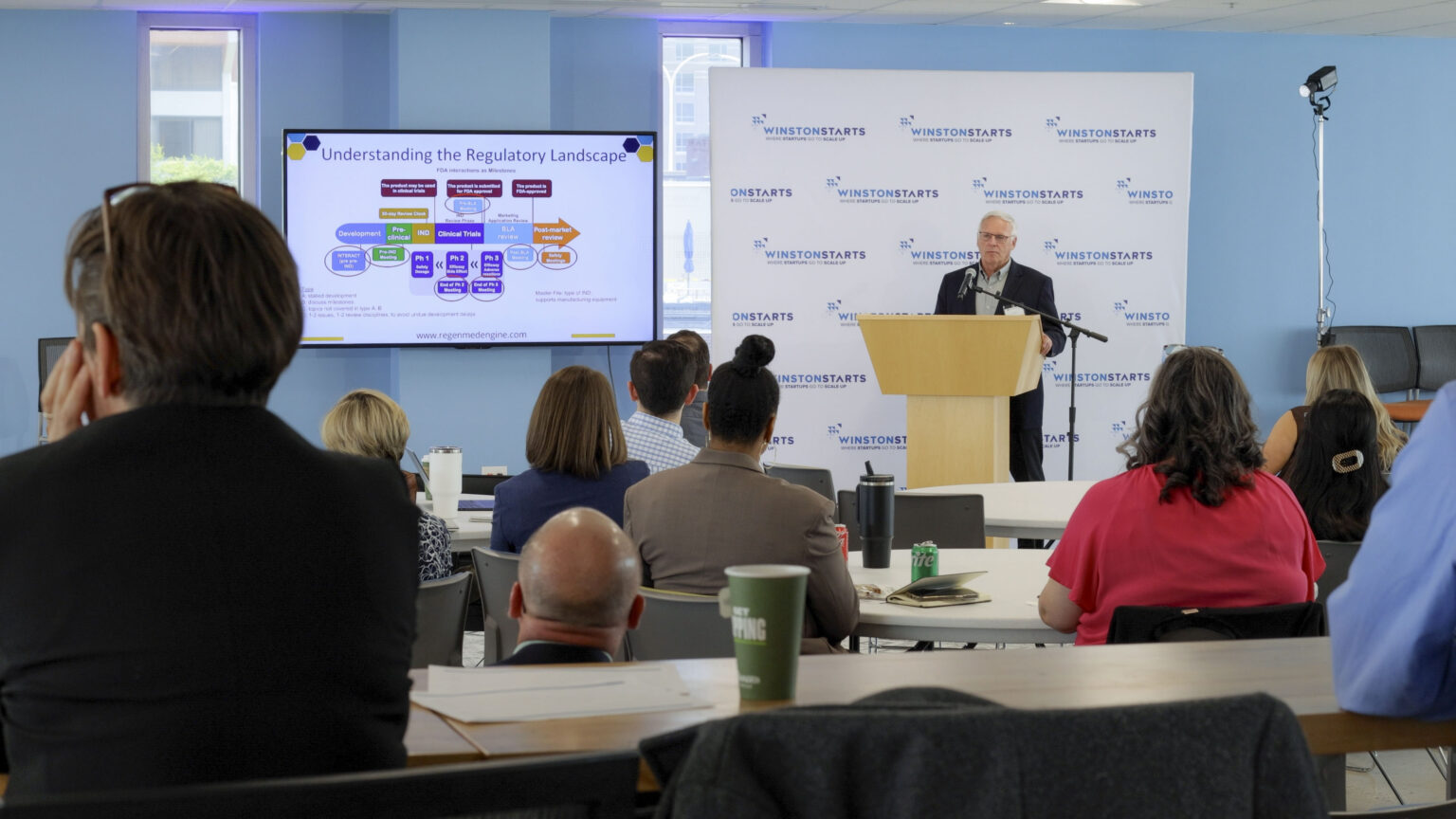
Regulatory frameworks must evolve to keep pace with innovation while maintaining safety. Collaboration among regulators, researchers and industry will shape policies that foster innovation without compromising safety, and the NavigatOR is expanding to help lead that work.
Adding subject matter experts in adjacent regulatory fields to meet growing demand as the Engine expands across the state.
Working with industry and agencies such as NIST to develop formal standards that set clear benchmarks for regulatory success.
Building AI-driven tools for early review of regulatory applications so companies can catch issues before they submit.
Reach 67 hospitals and more than 1,000 outpatient facilities through a single IRB and contract approval process, with access to more than 5 million patients.
De-risk pilot research with free access to prototype manufacturing, molecular genetics, tissue analysis and imaging equipment.
Join the NSF Regenerative Medicine Engine ecosystem to work with the Regulatory NavigatOR on your product’s path to FDA.
Questions? Email info@regenmedengine.com